What happens inside your brain when you slow down, become aware and learn to be present?
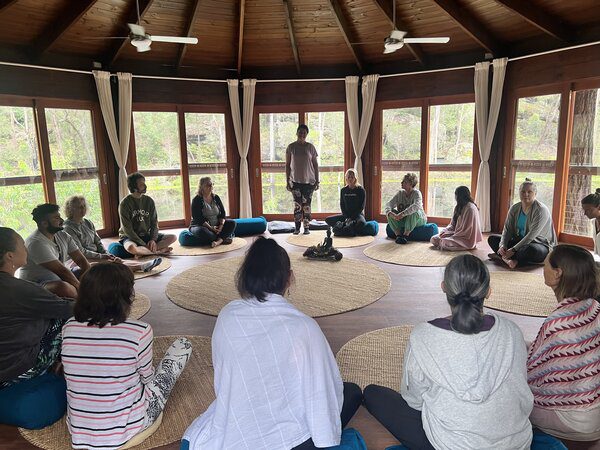
At Billabong Retreat, meditation is more than simply sitting quietly with your eyes closed. It is an opportunity to understand the extraordinary system that shapes how we think, feel, respond and experience the world.
During Tal Rafel’s Meditation Essentials workshop, we explore meditation through several approaches — including concentration, generative meditation, awareness, mindfulness and movement. At the heart of these practices is a fascinating question:
What actually happens in the brain when we learn to become more present?
Your brain is constantly responding
Our brains are designed to keep us safe.
When we experience stress, uncertainty or perceived threat, parts of the brain and nervous system can rapidly shift us into protective states — preparing us to fight, flee, freeze or otherwise respond.
At other times, we have greater access to reflection, perspective, decision-making and self-regulation.
Dr Dan Siegel describes this through the idea of integrating the “upstairs” and “downstairs” brain. His broader work on interpersonal neurobiology emphasises integration — connecting different parts of our experience, including thoughts, emotions and bodily sensations. This integration is associated with greater flexibility and resilience.
The important insight is that meditation isn’t about stopping the brain from thinking.
It is about changing our relationship with what the brain is doing.
From reacting to noticing
Think about the last time you felt overwhelmed.
Perhaps your heart began beating faster. Your thoughts became repetitive. Your attention narrowed. You reacted before you had time to consider how you wanted to respond.
Meditation creates an opportunity to notice these processes.
By repeatedly bringing attention back to the breath, the body, a sound, a sensation or an object of focus, we practise noticing when the mind wanders — and gently returning.
That simple act is a form of training.
Instead of automatically following every thought, we learn to recognise:
“I’m thinking.”
Instead of immediately becoming absorbed in an emotion:
“I’m experiencing an emotion.”
Instead of being completely carried away by stress:
“I’m noticing what is happening in my body.”
This shift from automatic reaction to conscious awareness is one of the reasons meditation has attracted so much scientific interest.
Your brain can change
The brain isn’t fixed. It continually adapts in response to experience, learning and behaviour — a quality known as neuroplasticity.
Research into meditation has found differences in brain structure and function between meditation practitioners and non-practitioners, although researchers continue to investigate exactly how much of these differences can be attributed to meditation itself.
Studies have reported differences involving areas associated with attention, memory, body awareness and emotional regulation. Research has also explored the hippocampus, prefrontal regions and amygdala in relation to meditation and mindfulness.
One particularly interesting area is the hippocampus, a structure involved in memory and spatial navigation. Research has found structural differences in the hippocampus of experienced meditators compared with control groups.
There is also research suggesting that long-term meditation may be associated with differences in age-related changes in grey matter. These findings are intriguing, but they should not be interpreted as proof that meditation can prevent brain ageing — the research is still developing, and many studies are observational.
The amygdala: your brain’s alarm system
Another part of the brain often discussed in meditation research is the amygdala.
The amygdala plays an important role in detecting and responding to emotionally significant or potentially threatening situations. It is part of the network involved in our fight-or-flight response.
Some research has found associations between meditation or mindfulness practice and changes in amygdala structure or activity, including research connecting mindfulness with the brain’s response to stress.
This gives us another way to think about meditation.
The goal isn’t necessarily to eliminate stress.
It may be to become better at recognising what is happening when stress arises — and creating a little more space around our response.
What is the “window of tolerance”?
When we are within our window of tolerance, we are generally better able to stay present, think clearly, connect with others and respond rather than simply react.
When stress becomes overwhelming, we can move outside that window — becoming highly activated, anxious or agitated, or alternatively feeling shut down, numb or disconnected.
Meditation, mindfulness, movement and awareness practices can give us tools for noticing these shifts.
A retreat environment can make this easier because there is space to slow the pace of everyday life and pay attention to things we might normally overlook:
How am I breathing?
What am I feeling?
Where do I hold tension?
What thoughts keep returning?
Can I observe them without immediately believing or acting on them?
These questions bring us back into relationship with our own experience.
Meditation isn’t about having an empty mind
One of the biggest misconceptions about meditation is that you need to stop thinking.
But thoughts are what brains do.
The practice is not to create a perfectly silent mind. Instead, it is to develop awareness of the mind’s movements.
You notice a thought.
You notice you’ve become distracted.
You return.
And then, inevitably, you get distracted again.
You return again.
This is the practice.
Over time, that repeated movement between distraction and returning may help strengthen our capacity to place and redirect attention. Research into mindfulness has investigated changes in brain regions involved in attention, memory, self-regulation and emotional processing.
Bringing the brain and body together
Perhaps the most valuable lesson is that the brain doesn’t exist in isolation.
Our thoughts, emotions, breathing, sensations and movements are constantly interacting.
This is why meditation doesn’t have to mean sitting perfectly still.
Tal’s workshop explores several pathways into meditation — from concentration and awareness to movement — recognising that there are different ways to cultivate presence.
Sometimes the way into a quieter mind is through the breath.
Sometimes it is through movement.
Sometimes it is simply noticing a sensation in the body.
And sometimes it is learning to observe the mind without needing to change anything at all.
A practice you can take home
The next time you feel caught in a busy mind, try this simple practice:
Pause.
Take one slow breath.
Notice what you can feel in your body.
Notice what your mind is doing.
Rather than trying to push the thoughts away, simply recognise them.
Then gently bring your attention back to your breath or to the sensations in your body.
You don’t need to do it perfectly.
You are simply practising the ability to notice, return and begin again.
And perhaps that is one of the most beautiful things about understanding the brain: we begin to realise that we don’t have to be controlled by every thought, emotion or reaction that passes through us.
With awareness, we can create a little more space.
And in that space, we may find a different way of responding.
Come and explore your own mind
At Billabong Retreat, meditation is an invitation to slow down, reconnect and become curious about the experience of being human.
Through practices that cultivate concentration, awareness, mindfulness and embodied presence, we can begin to understand not only how the mind works — but how we relate to it.
Because understanding your brain isn’t about controlling every thought.
It’s about learning to meet your experience with greater awareness.
Based on insights shared by Tal Rafel in the Meditation Essentials workshop at Billabong Retreat, incorporating contemporary research into meditation, mindfulness and the brain.